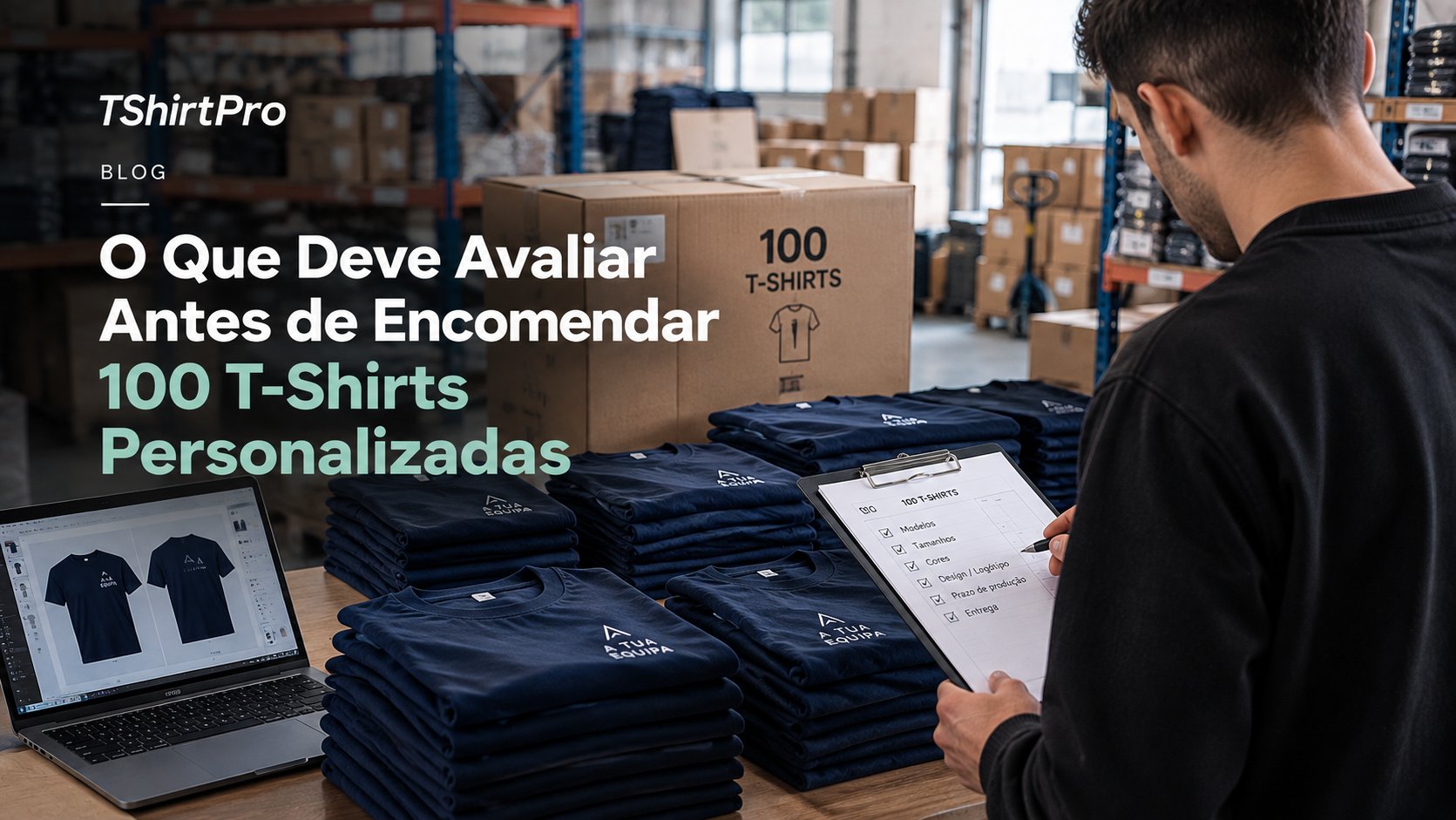
What to Consider Before Ordering 100 Custom T-Shirts
Equipa TShirtPro
Ordering 100 custom T-shirts is quite different from ordering just one or two units.
When we are talking about a larger order, small decisions can have a significant impact on the final result: the model chosen, the size distribution, the position of the logo, the size of the personalisation, or even the date on which you need the garments.
That is why, before going ahead with an order of 100 custom T-shirts, it is important to settle every detail.
At TShirtPro, the process has been designed to make this preparation simpler. You can choose the model, set the quantity and size distribution, select the personalisation and see the price directly in the online configurator.
In this guide we go through the main points you should assess before closing an order of 100 units.
1. Start with the purpose of the order
Before choosing the T-shirt, think first about how the garments are going to be used.
An order of 100 T-shirts for a team of employees may have very different requirements from an order for an event, a promotional campaign, a sporting event or a clothing brand.
The most common uses include:
clothing for companies and teams;
events and festivals;
promotional campaigns;
clubs and associations;
sporting events;
merchandising;
marketing activities;
groups and organisations.
Defining the purpose helps you make a better choice of model, of type of personalisation and even of the level of quality that makes most sense for the project.
A T-shirt worn by a professional team, for example, may call for a different choice from a garment handed out at a one-day event.
2. Choose the right model
Not all T-shirts answer the same need.
Before ordering 100 units, you should assess factors such as the cut, the fabric weight, the material, the comfort and the intended use.
At TShirtPro there are different T-shirt solutions, including models geared towards professional use, premium options and technical or sports models.
The choice should take into account not only the price, but also the way the garment will be used and the perception you want to convey.
A lighter, more versatile T-shirt
A 150 g/m² T-shirt can be an interesting solution when quantity, comfort and budget need to be balanced.
It is a versatile option for companies, events, groups, campaigns and other uses where large quantities may be required.
Premium T-shirt
A fuller-bodied T-shirt can make sense when the perceived quality of the garment matters particularly.
For merchandising, brands or prolonged use, characteristics such as the feel, the cut, the finishing and the fabric weight can carry more weight in the decision.
Technical or Sports T-shirt
When the garments are intended for physical activities, races, clubs or other sporting events, a technical T-shirt may be more suitable.
The important thing is not to start with the quantity. Start with the use.
3. Define the quantity and the sizes correctly
When we talk about 100 T-shirts, it is not enough to know that you need 100 units.
You also need to work out how those 100 units will be distributed.
For example:
10 × S
25 × M
35 × L
20 × XL
10 × XXL
The distribution will depend on your team, your audience or your event.
When configuring the order you can spread the units across the different sizes available, which avoids having to create a separate order for each size.
This is a decision that should be taken before going ahead, because in an order of 100 units a mistake in the distribution can mean several garments that do not fit the recipients.
Do you not yet know the exact distribution?
Before finalising the order, try to arrive at least at a realistic estimate.
In the case of companies, you can start by collecting your employees' sizes.
At an event, you can use the registration data or an estimate based on the expected turnout.
The closer the distribution is to the real need, the lower the risk of ending up with a surplus of certain sizes.
4. Choose the colour strategically
The colour also deserves attention.
In a corporate context, it usually makes sense to consider the colours of the company's visual identity.
At an event or within a group, there may be a colour associated with the organisation, the campaign or the event itself.
But you should not look at the colour of the T-shirt alone.
You also need to consider how the design is going to work on that colour.
A logo designed for a white garment may need to be adapted when it is applied to a black one.
The same is true of other strong or dark colours.
That is why the combination of garment and personalisation should be thought through together.
5. Define where the personalisation will be applied
Another important point before ordering 100 units is deciding exactly where you want to place the design.
The most common options include:
front;
back;
front and back;
other personalisation areas available.
A small mark on the chest conveys a completely different message from a large print on the back.
Before going ahead, you should define:
where the personalisation will be applied;
what its approximate size will be;
whether there is more than one personalised area;
whether the same application will be used on every garment.
These choices also have an impact on the final price of the order.
So the better defined the configuration is, the easier it will be to understand the investment required.
6. Do not underestimate the design file
Having a logo or an image does not necessarily mean that the file is prepared in the best way for production.
One of the most common mistakes is reaching the final stage of the order and discovering that the file needs to be adjusted.
It may happen, for example, that:
the resolution is insufficient;
there are elements that need to be corrected;
the logo has a background that should not be there;
the proportions are not right;
the design was not prepared for the intended size.
This does not mean you have to master graphic preparation.
At TShirtPro, before production, the material you have sent is reviewed and a digital mock-up is prepared for approval.
This way, you can see how the personalisation will look on the garment before production goes ahead.
7. See the mock-up before producing 100 units
The larger the order, the more important it becomes to validate the result before production.
Imagine producing 100 T-shirts and only then realising that the logo came out too big, too small, or in a different position from the one you had in mind.
It is precisely to avoid this kind of situation that the mock-up plays an important role.
The mock-up lets you see the design applied to the garment and confirm aspects such as:
position;
proportion;
size;
visual arrangement;
application of the logo or graphic.
At TShirtPro, the order goes through this preparation process before production.
The aim is simple: to make sure that what you pictured matches the result that is going to be produced.
8. Compare the price taking the whole configuration into account
When you receive a price for 100 T-shirts, you should not look only at the amount per unit.
It is important to understand what is included in that configuration.
The price of an order can vary according to factors such as:
the T-shirt model;
the quantity;
the size of the personalisation;
the number of personalised areas;
the configuration chosen.
For example, 100 T-shirts with a small print on the front do not necessarily cost the same as 100 T-shirts with large prints on the front and back.
So comparing unit prices alone, without making sure the configurations are the same, can lead to the wrong conclusions.
Ideally, you should compare equivalent solutions.
9. Run a simulation before deciding
While you are still weighing up options, it can be useful to test different configurations.
At TShirtPro, the configurator lets you select the product, the colour, the quantities, the sizes and the personalisation areas and see the corresponding price.
This allows you to test, for example:
100 units vs. other quantities;
standard T-shirt vs. Premium;
one personalisation area vs. two;
different print sizes;
different models or colours.
That way, you can see how small changes may affect the final investment before completing the order.
10. Do not leave the deadline until the last minute
An order of 100 T-shirts should be planned in advance.
Even when the buying process is simple, there are several stages between the decision and receiving the garments:
choosing the product;
configuring the order;
sending the design;
preparing the mock-up;
approval;
production;
dispatch.
If the T-shirts are needed for a specific date, the lead time should be taken into account from the outset.
This is especially important for:
events;
festivals;
sporting events;
campaigns;
launches;
corporate activities;
seasonal activities.
The closer the event is, the less room there is to correct changes or unforeseen problems.
11. Think about what happens after the first 100 units
An order of 100 T-shirts may be just the beginning.
For a company, for example, there may be a future need for:
new garments for employees;
restocking sizes;
new hires;
new events;
new campaigns;
complementary garments.
So when choosing the model, it is worth thinking about continuity as well.
A consistent visual identity makes it simpler to keep using the same clothing line over time.
And the need may not be limited to T-shirts.
A clothing solution can also be rounded out with custom sweatshirts, hoodies and other garments.
12. Checklist before ordering 100 T-shirts
Before finalising the order, confirm that:
☑ The purpose of the order is defined.
☑ The model chosen is suited to the use.
☑ The colour is decided.
☑ The size distribution is correct.
☑ You know where you want to apply the personalisation.
☑ The size of the design is defined.
☑ The file is ready.
☑ The mock-up has been reviewed and approved.
☑ The price matches exactly the configuration you want.
☑ The date on which you need the garments has been taken into account.
☑ The solution chosen can continue to be used in future orders.
If these points are settled, the process becomes much simpler and the likelihood of problems during production drops significantly.
How much does it cost to order 100 custom T-shirts?
There is no single price for an order of 100 custom T-shirts.
The amount depends on the configuration chosen.
The T-shirt model, the quantity, the type and size of the personalisation and the number of personalised areas can all change the final price.
So the simplest way to find out what your order will cost is to configure the project directly.
You can choose the model, enter the quantities, select the sizes and define the personalisation in order to see the corresponding price.
Can I mix different sizes in an order of 100 T-shirts?
Yes.
You can spread the 100 units across the different sizes available according to the needs of your team, group or event.
For example, you can combine S, M, L, XL and XXL within the same order.
This makes it possible to adapt production to the people who will be wearing the garments.
Do I need to have the final design ready before calculating the price?
Not necessarily.
You can start by configuring the order on the basis of the model, quantity, sizes and personalisation areas you want.
That way, you get an idea of the investment before finalising all the graphic details.
The design can then be prepared and validated through the mock-up before production.
What happens after I place the order?
Once you have configured the order and sent the necessary material, the team prepares production and the corresponding mock-up for validation.
This step is especially important on larger orders because it allows the expected result to be confirmed before the garments are produced.
Conclusion: what should you really assess before ordering 100 T-shirts?
An order of 100 custom T-shirts begins long before the buy button.
The choice of model, the size distribution, the colour, the position of the design, the preparation of the file, the approval of the mock-up and the deadline are all elements that need to be considered.
The clearer each of these points is, the simpler the process will be and the more predictable the final result.
At TShirtPro, the aim is precisely to simplify this preparation, letting you configure the order online, see the price and validate the personalisation before production.
Ready to create your custom t-shirts?
Configure online and get a free mockup within 24h.
Start configuring