How to Reduce the Complexity of Corporate Clothing Orders
Equipa TShirtPro
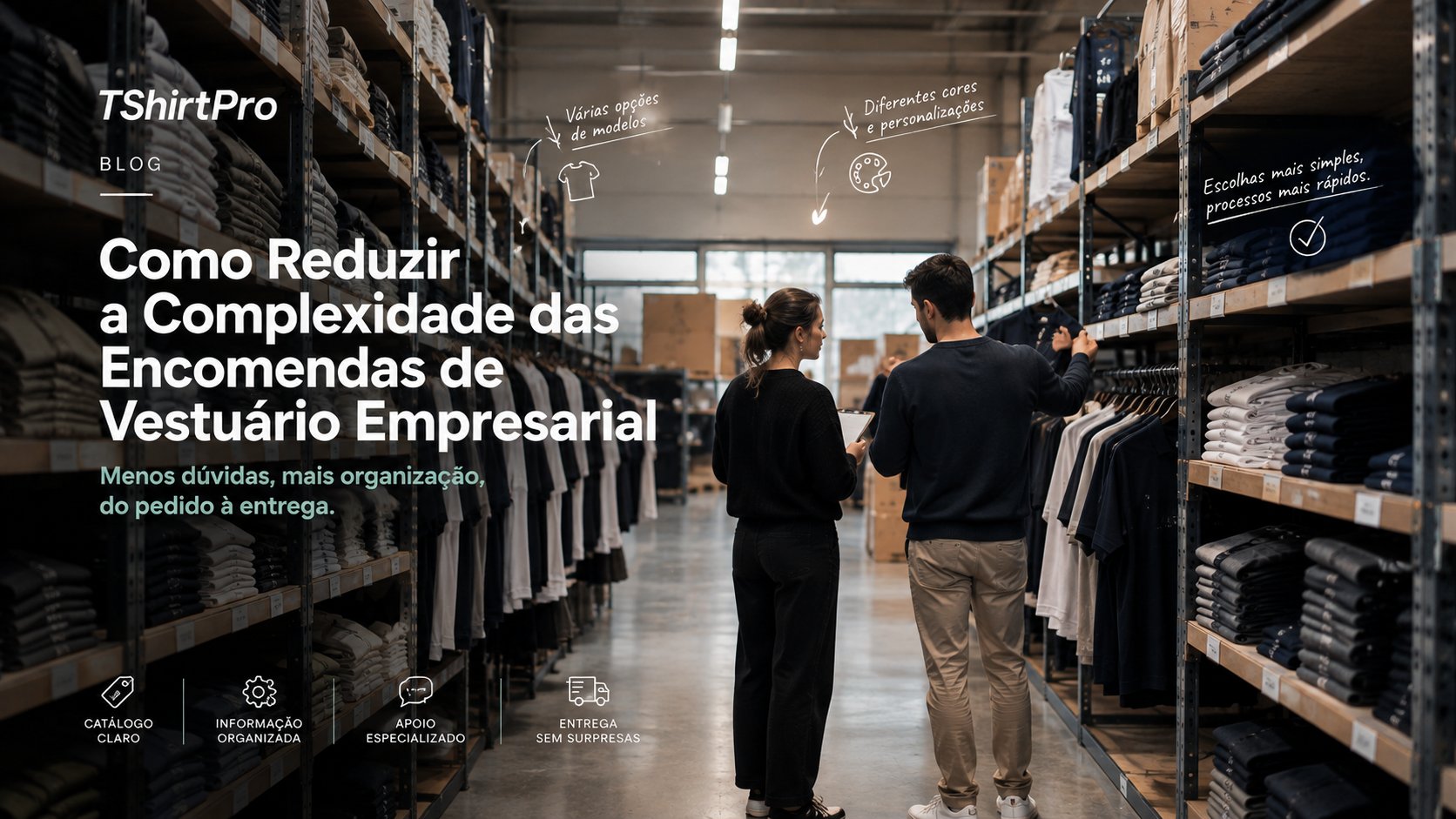
Ordering custom clothing for a company can look simple.
Pick a garment, add a logo and send it to production.
In practice, a corporate order can involve a number of decisions: styles, colours, sizes, quantities, print positions, files, mock-up approval, lead times and delivery.
When there is a team of several people, several garments or a large number of units, the complexity rises quickly.
That is precisely why the buying process should be designed to cut out unnecessary decisions and make every stage clearer.
At TShirtPro, the approach is to simplify the purchase of custom clothing through an online experience in which the customer can choose the product, configure the order, see the price and follow the process.
In this article we show how to reduce the complexity of corporate clothing orders and make the whole process easier to manage.
Why can corporate orders become complex?
A company order is rarely just a question of quantity.
It may involve, for example:
- different styles;
- several colours;
- several sizes;
- different teams;
- different print areas;
- graphic files;
- specific lead time requirements;
- future top-ups.
What is more, when the process relies entirely on manual communication, every change can mean new emails, new confirmations and new versions of the request.
Simplifying therefore does not just mean producing faster.
It also means reducing the number of decisions and tasks the customer has to manage by hand.
1. Start by defining exactly what the company needs
One of the best ways to reduce complexity is to start from the need rather than from the product.
Before choosing any garment, answer a few questions:
Who is going to wear the clothing?
In what setting?
During which season?
How often?
How many people will receive the garments?
Is there a need for different styles?
For example, a company may need:
- T-shirts for everyday use;
- sweatshirts for the colder months;
- jackets for outdoor teams.
Rather than treating these needs as completely separate orders, it can be simpler to think in terms of one coherent clothing solution.
2. Reduce the number of unnecessary decisions
The more options there are, the more time choosing can take.
That does not mean variety is a bad thing.
It means the process should help the customer quickly see which options are relevant to their case.
For example, instead of comparing dozens of references without context, it can be simpler to start from levels of use:
Everyday use
Premium / image
Sport
Outdoors
From there, the choice becomes more objective.
The same principle can be applied to different garments.
T-shirts, sweatshirts, hoodies and jackets can be chosen according to their use and not only on appearance.
3. Centralise the order configuration
One of the main factors that can complicate a corporate order is having information scattered across several channels.
The quantity in an email.
The sizes in an Excel sheet.
The design in a folder.
Changes in another message.
Confirmation through another contact.
The more the information is scattered, the greater the chance of an error.
A centralised configuration makes it possible to bring together in a single process:
- product;
- colour;
- quantity;
- sizes;
- personalisation;
- file;
- price.
At TShirtPro, the online configurator was designed precisely to bring this information together in a single buying experience.
4. Organise the size distribution before ordering
In corporate orders, the total quantity is only part of the information.
Imagine an order of 100 garments.
What matters is not just knowing that there are 100 units.
You also need to define how many will be S, M, L, XL, XXL or other applicable sizes.
An organised distribution avoids separate orders and reduces the chance of errors.
At TShirtPro, the units can be distributed across the different sizes within the order configuration.
Good practice is to gather this information internally before starting the final configuration.
5. Have a clear rule for the design
Another point that can create complexity is the personalisation.
A team may debate:
- the size of the logo;
- its position;
- front or back;
- colours;
- different versions of the brand mark.
When there is no clear decision, every change can mean going back over the request again.
It is therefore useful to define in advance:
Which is the official logo?
Where will it go?
Roughly what size will it be?
Will it be the same on every garment?
The more consistent the design, the simpler production will be.
6. Use the mock-up as an approval stage
The mock-up is one of the most important tools for reducing uncertainty before production.
Instead of trying to imagine how the design will look on the garment, the company can see the proposal before anything is printed.
The mock-up makes it possible to check, for example:
- position;
- size;
- proportion;
- visual arrangement;
- how the logo is applied.
At TShirtPro, a mock-up is produced before printing, for approval.
This is especially relevant on larger orders.
If 100 or 500 garments are going to be produced, checking before printing can avoid changes later on.
7. Go for clear, configurable prices
Another frequent source of complexity is the quotation.
When every small change calls for a new price request, the company loses time comparing different scenarios.
A configurator that updates the figure according to the configuration makes that analysis much faster.
At TShirtPro, the price is calculated on the basis of elements such as the item, the quantity and the print areas.
This makes it possible to test different possibilities before going ahead.
For example:
50 vs. 100 units
standard T-shirt vs. Premium
One print area vs. two
T-shirt vs. sweatshirt
Instead of imagining the impact of each change, you can compare the different configurations.
8. Have a simple process for sending the files
The design file should not be a barrier to placing the order.
A company may have a logo created several years ago, an image produced by an agency, or simply a file that is not ready for production.
The process should therefore allow you to send whatever material you have and deal with the technical side when needed.
What matters is that there is a review and approval stage before production.
At TShirtPro, the material you send is reviewed and the mock-up lets you check how it is applied before going ahead.
9. Choose a supplier able to handle different garments
Complexity also increases when a company has to work with several suppliers.
One for T-shirts.
Another for sweatshirts.
Another for hoodies.
Another for jackets.
As well as making management heavier, this can make it harder to maintain a consistent visual identity.
Having access to different clothing categories through the same supplier can simplify the process.
TShirtPro's expansion includes T-shirts, sweatshirts, hoodies and other garments, making it possible to create more complete clothing solutions.
10. Think of the order as part of an ongoing process
For many companies, custom clothing is not a one-off need.
There are new hires.
New events.
Top-ups.
Campaigns.
Changes of season.
New teams.
It is therefore important to choose a process that is easy to repeat.
Saving the configuration, keeping the same design and having a clear record of what was produced before can greatly reduce the work on subsequent orders.
A well-organised order today can make every order that follows easier.
11. Centralise the order tracking as well
The complexity does not end at the moment of purchase.
After payment, the company may still need to know:
- whether the order has been validated;
- whether the mock-up has been approved;
- whether it has gone into production;
- whether it is being packed;
- when it will be dispatched.
Having access to the order status makes the process more predictable.
At TShirtPro, the customer can follow the progress of the order, with different statuses linked to production.
12. Appoint someone internally to take charge
Even with a simple process, there is one very effective way of reducing complexity:
having one person responsible for the order.
Instead of ten people sending different changes, there can be one person responsible for:
- collecting the sizes;
- approving the style;
- signing off the design;
- confirming quantities;
- following production.
This greatly reduces the chance of contradictory instructions.
13. Build a basis for future orders
A company that uses custom clothing regularly benefits from keeping some information organised.
For example:
Style: Premium T-shirt
Colour: Black
Personalisation: Logo on the front
Size: A6
Usual distribution: S / M / L / XL
Design: approved file
This information can serve as a starting point for a new order.
The aim is not to start from scratch every time a new need arises.
Checklist for simplifying a corporate order
Before going ahead, confirm:
☑ You know who will be wearing the garments.
☑ You know which styles are needed.
☑ You have the quantity defined.
☑ You have the size distribution.
☑ The colour is decided.
☑ The logo/design is chosen.
☑ You know where you want the print.
☑ The price can be checked for the chosen configuration.
☑ There is a mock-up approval stage.
☑ The lead time is set.
☑ You know how to track the order.
☑ The configuration can be repeated in the future.
The more of these points are settled from the outset, the simpler the process will be.
How can you make a corporate clothing order more efficient?
Simplification begins before the order.
An efficient process should reduce manual tasks, centralise information and allow the customer to make decisions clearly.
Instead of:
Email → quotation → change → new quotation → file → correction → confirmation → production
the aim should be to move the process closer to:
Choice → configuration → price → design → mock-up → approval → production
It is this logic of simplification that sits at the heart of what TShirtPro offers: making the purchase of custom clothing simpler, more transparent and faster for companies and organisations.
Frequently asked questions
What is the trickiest part of a corporate order?
Complexity usually rises when there are many variables at once: different garments, sizes, quantities, prints and lead times.
Centralising that information helps to reduce errors and unnecessary back-and-forth.
Is it better to place a single order for the whole company?
It depends on the need.
If different teams need different garments, it can make sense to organise everything within a common logic, even if there are several items.
What matters is keeping the process organised and the visual identity consistent.
Do I need to know how to prepare files for printing?
Not necessarily.
Ideally, the supplier will be able to review the material you send and tell you when an adjustment is needed before production.
Is the mock-up important on every order?
It is particularly useful when the position, size and appearance of the design matter, or when there are many units involved.
It lets you check the result visually before production.
How can I make future orders easier?
Keeping a record of the style, colour, sizes, personalisation and file used can make the next orders much faster.
It also helps to choose a supplier whose process makes it easy to repeat the configuration.
Conclusion: simplifying starts before you order
A corporate clothing order does not have to be a complex process.
When the information is centralised, the options are clear, the price is transparent and there is an approval stage before production, much of the complexity can be removed.
For companies, that means less time wasted, less unnecessary back-and-forth and greater control over the final result.
At TShirtPro, the process was designed precisely to simplify this experience: choose, configure, check the price, send the design, approve the mock-up and track the order, all within one online process.
Are you preparing a clothing order for your company?
Start by defining the garments, quantities and personalisation you need, and explore the options available at TShirtPro.
Ready to create your custom t-shirts?
Configure online and get a free mockup within 24h.
Start configuring