What Custom Clothing Should a Company Have? A Guide by Type of Use
Equipa TShirtPro
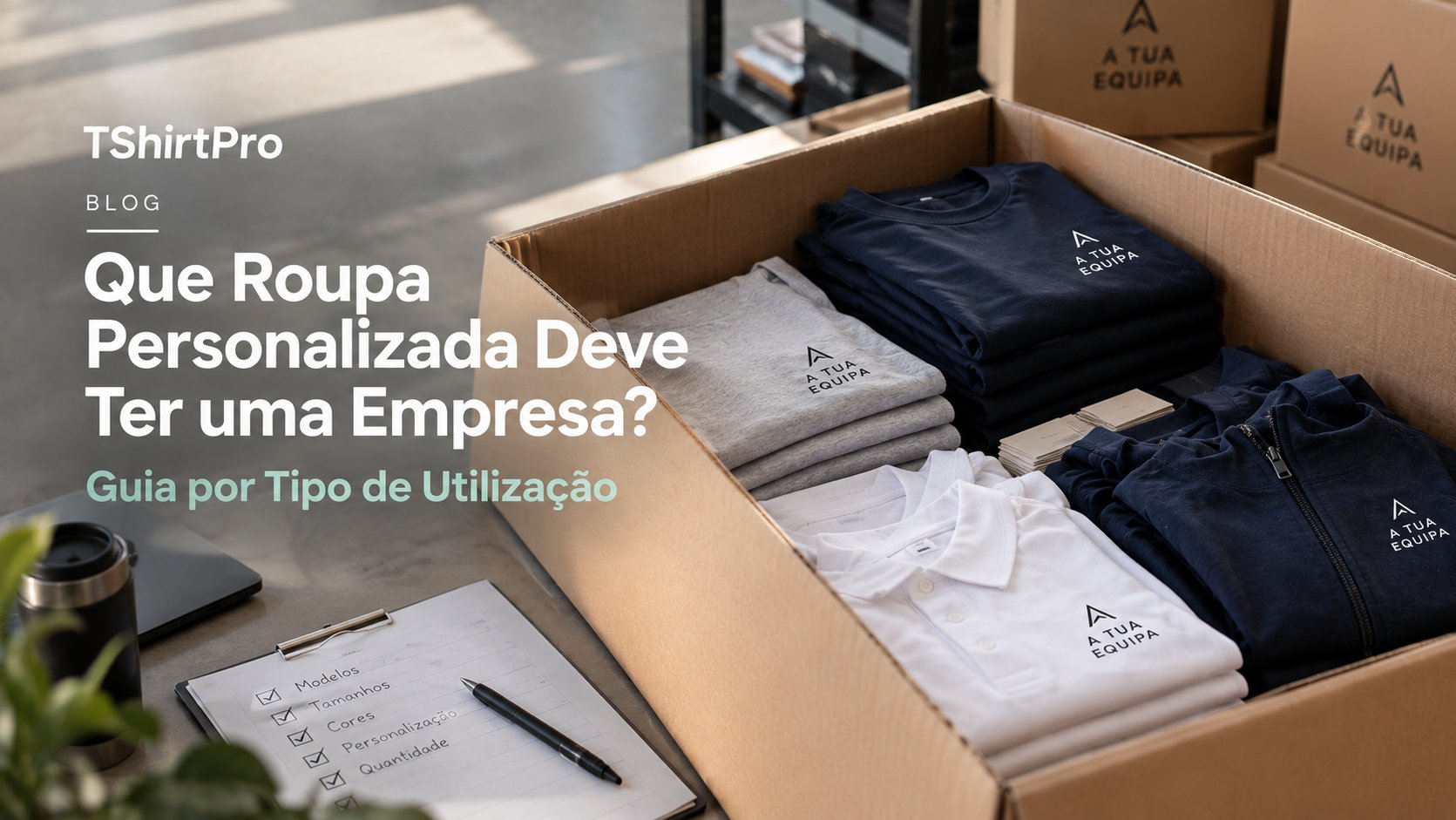
What Custom Clothing Should a Company Have? A Guide by Type of Use
When a company starts thinking about custom clothing, it usually starts with T-shirts.
They are versatile, simple to personalise and can be used in many settings. But depending on the team's role, the time of year, the working environment or the type of activity, a T-shirt may not be enough.
Today, custom clothing can include different types of garments: T-shirts, sweatshirts, hoodies, zip-up sweatshirts and jackets, among other options.
So the real question becomes a different one:
Which garments genuinely make sense for your company?
The answer depends on how the clothing is going to be used.
A team working in an office does not necessarily have the same needs as an installation team, a restaurant, a logistics company or an organisation that takes part in outdoor events.
In this guide we show which types of custom clothing can make sense for different uses, and how to build a more complete clothing solution.
Why should a company think beyond a single garment?
A company's clothing does not have to consist of a single style.
In reality, many companies have different needs over the course of the year.
During the warmer months, a T-shirt may be enough. When temperatures drop, a sweatshirt, a hoodie or a jacket may become more suitable.
In the same way, one garment may be intended for daily use, while another may be worn at events, promotional activities or specific activities.
Having different garments makes it possible to maintain a consistent visual identity without forcing every setting to use exactly the same type of clothing.
For example, a company can build a solution made up of:
- T-shirts for the warmer months;
- sweatshirts for mid-season;
- hoodies for more casual use;
- jackets for outdoor environments or colder periods.
The most important thing is that all of these garments can keep a coherent visual line through the same colours, logo and brand identity.
1. Custom T-shirts for everyday use
T-shirts remain one of the most versatile options for companies.
They can be worn by internal teams, by staff who deal directly with customers, and at events, promotional activities, campaigns, groups or teams.
They are especially worth considering when:
- the company is looking for a simple, versatile garment;
- there is a need to produce several units;
- the clothing is worn in informal environments;
- there are activities or events with many participants;
- the team works mainly indoors or during warmer periods.
A T-shirt can work both as clothing and as a means of identification.
When every member of staff wears the same custom garment, creating a coherent visual image becomes much simpler.
T-shirts for teams and companies
In a business context, a small logo print may be enough to identify the team.
In other cases, it may make sense to use a larger print or to combine front and back.
The decision should depend on the intended use and on the image the company wants to convey.
2. Custom sweatshirts for mid-season
When temperatures start to fall, the sweatshirt becomes one of the most practical garments to complement a corporate clothing solution.
It is especially useful for companies that want to:
- extend the use of custom clothing throughout the year;
- equip teams working in cooler environments;
- create a coordinated set of garments;
- offer an alternative to the T-shirt.
One of the main advantages is being able to maintain the company's visual identity outside the warmer months as well.
For example, a team can wear a custom T-shirt during the summer and carry the same identity over to a sweatshirt during the mid-season.
3. Custom hoodies for more relaxed use
Hoodies have been gaining ground in corporate clothing, especially in companies with a more informal culture or in settings linked to creativity, technology, communities and brands.
They can be used for:
- internal teams;
- events;
- merchandising;
- branding activities;
- campaigns;
- communities;
- brands;
- companies with an informal working environment.
Beyond its practical function, the hoodie can also take on a role connected to company culture and team identification.
It is possible to create a garment that staff wear at work and outside work too, keeping the brand identity present.
4. Custom jackets for outdoor use
For some companies, T-shirts and sweatshirts are not enough.
When there are staff who spend part of the day outdoors, travel between different sites or work during colder seasons, a jacket can be an important part of the clothing solution.
It can be relevant for:
- technical teams;
- maintenance;
- logistics;
- sales teams on the road;
- event organisation;
- companies with outdoor work;
- teams that need an extra layer during the colder months.
In this type of use, the clothing does not serve only a visual purpose.
There is also a practical need linked to the environment the team works in.
The jacket can therefore complement the other garments and make it possible to maintain the company's identity in settings where a T-shirt or sweatshirt would not be enough.
5. Custom clothing for technical teams
Companies with teams that spend much of the day away from the office usually have different needs.
Construction, maintenance, installation, logistics, technical support or other services may call for garments suited to different working and temperature conditions.
In these cases, it may make sense to create a set rather than choosing a single garment.
For example:
T-shirt + sweatshirt + jacket
During the summer, the T-shirt may be enough.
In the mid-season, the sweatshirt may become the main option.
In colder periods or outdoor situations, the jacket can complete the solution.
This combination makes it possible to keep a consistent visual line throughout the year.
6. Custom clothing for events
Events are another context in which different garments can serve distinct purposes.
A race, a festival, a corporate activity or a brand event do not necessarily need the same type of clothing.
In some cases, a T-shirt will be enough.
In others, especially at events held outdoors or during colder seasons, it may make sense to have sweatshirts, hoodies or jackets.
The clothing can work as:
- team identification;
- a visual element of the event;
- merchandising;
- a support garment;
- a keepsake;
- a brand communication element.
The choice should be made bearing in mind the duration, the location and the characteristics of the event.
7. Custom clothing for brands and merchandising
For a brand, the choice of garment can be even more important.
In this context, the end customer is not simply buying a garment with a logo on it.
They are buying a product associated with the brand's identity.
T-shirts, hoodies, sweatshirts and other garments can therefore be used to build different collections or lines within the same visual identity.
A brand might, for example, start with a small collection of T-shirts and later add:
- hoodies;
- sweatshirts;
- zip-up sweatshirts;
- jackets.
In this way, custom clothing stops being just a promotional item and becomes part of the brand's own offering.
8. Custom clothing for companies with different teams
Not all staff necessarily need the same garments.
A company may have a sales team, a technical team, front-of-house staff and administrative staff, each with different needs.
In these cases, it may make sense to create a common visual line and adapt the garments to each team's role.
For example:
Sales team: T-shirt.
Technical team: T-shirt, sweatshirt and jacket.
Events: T-shirt or hoodie.
Internal team: sweatshirt or hoodie.
The goal is not for everyone to wear exactly the same clothing.
The goal is for the company to maintain a recognisable visual identity across different settings.
9. The visual identity should carry across the garments
When a company uses different types of clothing, there is one particularly important point: visual coherence.
It is not necessary for every garment to be identical.
But there should be elements that make the brand recognisable.
That coherence can be created through:
- corporate colours;
- the logo;
- the brand's placement;
- the size of the print;
- the visual style;
- the combination between different garments.
That way, even when one member of staff is wearing a T-shirt and another a jacket, both remain visually associated with the same company.
10. How many garments should each member of staff have?
This is one of the hardest decisions, because it depends very much on the context.
There is no universal number.
A team working in the office may need only a few custom garments.
A technical team that wears the clothing every day may need several units to allow for rotation and washing.
A company that takes part in events regularly may also keep specific stock for those occasions.
Before ordering, it is worth considering:
- how many staff will be wearing the clothing;
- how often;
- during which season;
- in which environments;
- whether the clothing will be strictly professional;
- whether there will be future top-ups.
This way, you can avoid both running short of garments and buying items that end up unused.
12. Corporate clothing does not have to stop at one order
One of the advantages of creating a line of custom clothing is being able to expand it over time.
A company can start with T-shirts and later add sweatshirts, hoodies or jackets.
It can also adapt the range when needs change.
A new team, a different season, a campaign or a change in visual identity can all create new needs.
So when choosing your first garments, it can be worth thinking about the possibility of keeping the same line in the future.
Conclusion: what is the best custom clothing for a company?
There is no single garment that is ideal for every company.
The choice depends on the use, the activity, the working environment, the time of year, the team's profile and the image the company wants to convey.
For some companies, a T-shirt will be enough.
For others, it will make more sense to combine T-shirts, sweatshirts, hoodies and jackets.
The most important thing is to create a solution that is useful for the people who will wear the garments and, at the same time, maintains a consistent visual identity.
At TShirtPro, the custom clothing range makes it possible to build different solutions according to each need, from T-shirts through to sweatshirts, hoodies, zip-up sweatshirts and outdoor garments.
Ready to create your custom t-shirts?
Configure online and get a free mockup within 24h.
Start configuring