
How to Choose the Custom Clothing Supplier for Your Company
Equipa TShirtPro
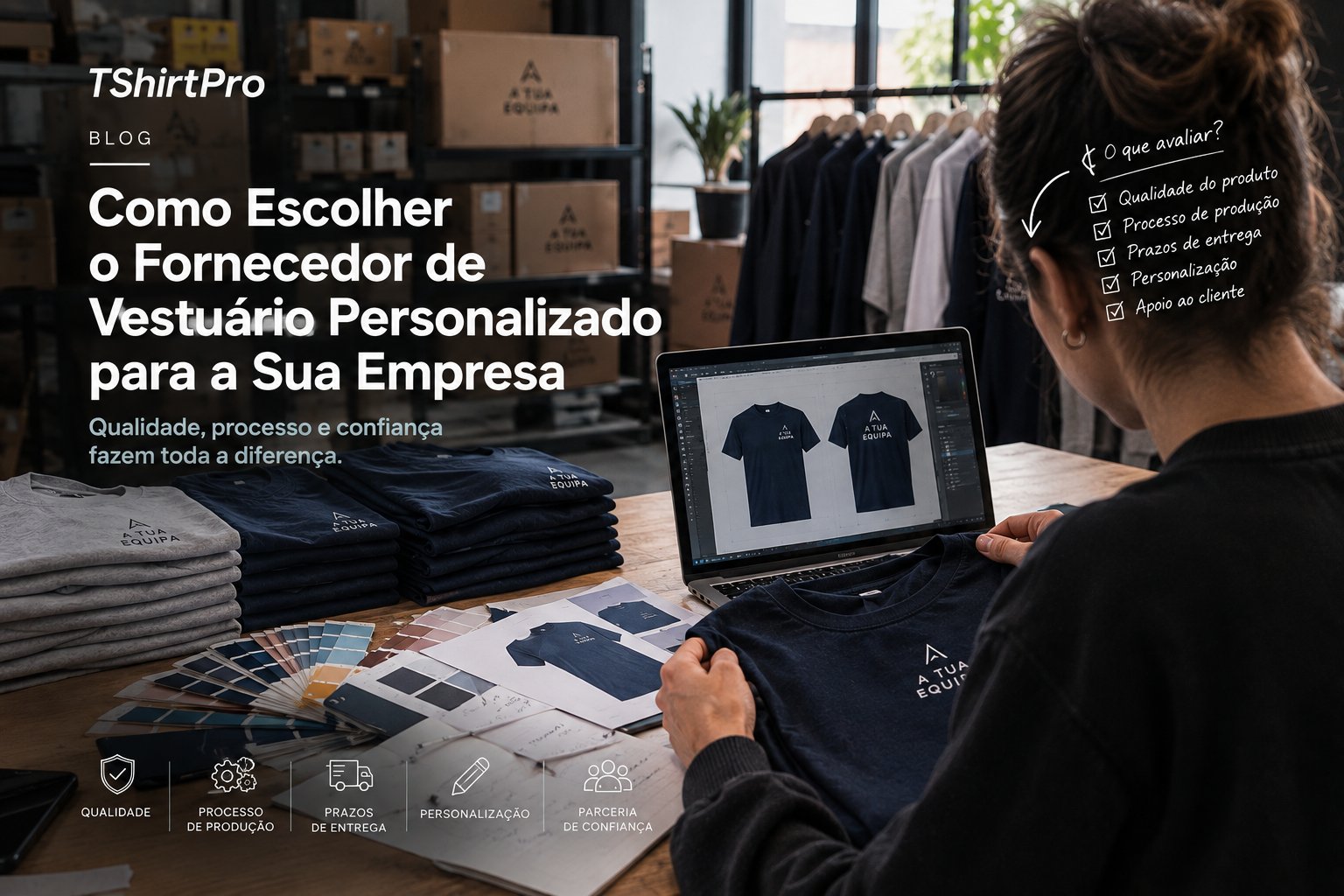
How to Choose the Custom Clothing Supplier for Your Company
Choosing a custom clothing supplier for a company should not come down to finding the lowest price.
When we are talking about a few dozen or a few hundred garments, the decision involves far more than the unit price. The style of the garment, the quality of the fabric, the printing method, the lead times, the design preparation and the ability to keep track of the order can all have a direct impact on the final result.
What is more, a company may not be placing just one order.
It may need clothing for a team, an event, a campaign, a new collection, new hires or future top-ups. In that context, choosing a supplier also means choosing a way of working that can keep up with those needs.
In this guide we have brought together the main criteria you should assess before choosing a custom clothing supplier for your company.
1. Start by understanding what you really need
Before comparing suppliers, it is important to define the need.
Not every company is looking for the same type of clothing, nor do they all have the same objectives.
You may be looking for:
- T-shirts for staff;;
- sweatshirts for everyday use;
- hoodies for events or merchandising;
- jackets for outdoor teams;
- clothing for events;
- garments for promotional campaigns;
- clothing for clubs or associations;
- merchandising for a brand.
It is also important to work out the approximate quantity, the sizes, the colours and the type of personalisation you want.
The clearer the need, the easier it will be to compare different suppliers.
2. Assess the quality of the garment, not just of the print
When it comes to custom clothing, it is easy to focus all your attention on the logo or the print.
But the garment itself also has a direct influence on the result.
The supplier should provide information clear enough about the styles it sells to let you understand differences in:
- weight;
- composition;
- cut;
- feel;
- comfort;
- intended use;
- product tier.
A T-shirt intended for a one-day campaign may have different requirements from a garment worn regularly by a team.
The same applies to sweatshirts, hoodies or jackets.
The question should not only be:
“How much does it cost to personalise this garment?”
but also:
“Does this garment make sense for the use I have in mind?”
3. Look at which types of garment the supplier can offer
A company may start with T-shirts, but its needs can grow.
It can therefore be important to choose a supplier with a broad enough range to keep pace with the company's development.
TShirtPro is currently expanding its range beyond T-shirts, with solutions such as sweatshirts, hoodies and outdoor garments.
This makes it possible to think of corporate clothing as a whole.
For example:
Summer: T-shirt
Mid-season: sweatshirt or hoodie
Winter / outdoors: jacket
This way, the company can keep a coherent visual identity across different garments and seasons.
4. Understand what the personalisation options are
Not all suppliers work in the same way.
Before going ahead, you should find out which possibilities are available for your project.
The elements to assess include:
- front;
- back;
- sleeve;
- size of the print;
- number of print areas;
- different colours;
- more complex designs;
- photographs or illustrations.
At TShirtPro, the configurator lets you select the print areas available and review the configuration matching your project.
The technology should also be considered in light of the need.
TShirtPro mainly uses DTF, bearing in mind that each technology has different characteristics and may be better suited to certain types of personalisation.
You do not need to be a printing expert to make this decision.
What matters is choosing a supplier able to guide the process and work with the solution best suited to the order.
5. Look for transparency in the price
Price is naturally one of the most important criteria.
But what matters most is not simply finding a low figure.
It is understanding what you are comparing.
A quotation can vary depending on:
- the style of the garment;
- the quantity;
- the size of the print;
- the number of areas;
- the colour;
- the type of product;
- other characteristics of the configuration.
Comparing suppliers on the final price alone may therefore not be enough.
Ideally, you should compare equivalent configurations.
In the case of TShirtPro, the price is calculated directly in the configurator according to the characteristics selected, allowing you to test different quantities, styles and print areas.
6. Check whether you can find out the price without turning everything into a manual process
For a company, time also has value.
If every small change means sending an email and waiting for a new quotation, the process can become slow.
An online system can make this stage easier.
At TShirtPro, the customer can select the item, quantity, sizes and print areas and see the price directly through the configurator.
This makes it possible to test different scenarios before making a decision.
For example:
- 50 vs. 100 units;
- standard vs. premium style;
- one print area vs. two;
- different sizes or configurations.
7. Confirm that there is an approval stage before production
This is one of the points that deserves the most attention in custom orders.
Imagine approving a run of 100 units without ever seeing how the design will actually look on the garment.
The position, the size or the proportions may not match what you had in mind.
It is therefore important to find out whether the supplier works with an approval stage.
At TShirtPro, a mock-up is produced before printing, so you can see and approve how the design is applied before going ahead.
This step is particularly relevant when the order is larger.
8. Look at the lead times and the production process
A good choice of supplier also depends on their ability to deliver when you need the garments.
Before ordering, confirm:
- the indicative lead time;
- the stages of the process;
- when the mock-up is approved;
- production;
- dispatch;
- order tracking.
According to TShirtPro's commercial documentation, the standard indicative lead time is 9 days, and priority terms are available on certain products, always subject to confirmation.
The most important thing is not to assume a lead time without checking that it applies to your order's specific configuration.
9. Ask how order tracking works
A custom clothing order does not end when the payment is made.
For a company, it can be important to know where production stands.
Questions such as:
Has the order gone into production yet?
Has the printing been done?
Is it being packed?
When will it be dispatched?
A process with tracking makes it simpler to manage expectations and internal planning.
TShirtPro provides an area where you can follow the status of your order, alongside internal sub-statuses linked to the different production stages.
10. Think about the capacity to handle large quantities
A supplier may handle a small order perfectly well and struggle when the volume increases.
So if your company works with larger quantities, this point should be part of the assessment.
Consider:
- production capacity;
- how orders are organised;
- size distribution;
- consistency of the printing;
- the ability to repeat production runs;
- the ability to keep up with future needs.
A company that orders 20 garments today may need 200 tomorrow.
The choice of supplier should take that potential into account too.
11. Consider the company's future needs
A relationship with a supplier need not be limited to a single order.
There may be a future need for:
- new garments for staff;
- restocking sizes;
- new hires;
- new events;
- new campaigns;
- new collections;
- different garments for other teams.
So when assessing a supplier, think about continuity as well.
Being able to keep the same visual identity across T-shirts, sweatshirts, hoodies and jackets can considerably simplify the management of a company's clothing.
12. Assess how easy it is to repeat an order
A common situation in companies is needing the same garment again a few months later.
In that case, the simpler it is to repeat the configuration, the better.
It helps to have:
- clear information on the previous configuration;
- the product reference;
- the design already prepared;
- the sizes defined;
- the order history.
This reduces the workload and makes restocking easier.
This aspect can matter a great deal, especially in companies that take on new staff frequently or have recurring needs.
13. A supplier should simplify, not complicate
In the end, one of the best indicators is understanding how the process works.
Is it simple to find the garment?
Is it easy to choose the quantity?
Can you see the price?
Do you know how to send the design?
Is there a mock-up?
Can you track the order?
The fewer unnecessary steps there are, the easier the purchase will be to manage.
That is exactly the thinking behind TShirtPro: turning the purchase of custom clothing into an online process that is simple, transparent and clearly priced.
Checklist: what should you assess before choosing?
Before going ahead with a supplier, confirm:
☑ Do they have the styles suited to your use?
☑ Do they offer different types of clothing?
☑ Do they have personalisation options suited to your design?
☑ Can you clearly see the price?
☑ Are there different options for different quantities?
☑ Is there a mock-up before production?
☑ Are the process and the lead times clear?
☑ Can you track the order?
☑ Do they have the capacity to handle larger volumes?
☑ Can they meet the company's future needs?
☑ Is it simple to repeat an order?
The more positive answers you have, the more information you will have to make an informed decision.
Is the cheapest supplier always the best choice?
Not necessarily.
Price should be part of the assessment, but it should not be judged in isolation.
A cheaper solution may differ in terms of the product, the personalisation, the process or the follow-up.
Equally, a higher-priced option may include features that are relevant to the company's objective.
The comparison should be made between equivalent configurations and with the expected final result in mind.
Conclusion: choosing a supplier means choosing a process
Choosing a custom clothing supplier for your company goes far beyond comparing prices.
It is important to assess the quality of the garments, the personalisation options, the transparency of the price, how easy the configuration is, whether a mock-up is produced, the lead times, the order tracking and the ability to meet future needs.
When all of these elements work together, the purchase becomes simpler and more predictable.
At TShirtPro, we aim to simplify that process through an online experience where you can choose the product, set the configuration, see the price and track the order, with a mock-up before production.
Ready to create your custom t-shirts?
Configure online and get a free mockup within 24h.
Start configuring