Screen Printing vs DTG vs DTF: Which Is the Best Technique for Custom T-Shirts?
Humberto
When creating custom t-shirts, the choice of printing technique is one of the most important factors in guaranteeing quality, durability and good value for money. Among the most widely used options today are screen printing, DTG (Direct to Garment) and DTF (Direct to Film). Each of these techniques has its own characteristics, which suit different needs.
Understanding the differences between these three approaches is essential in order to make an informed choice, whether for an event, for personal use or for company uniforms.
What screen printing is
Screen printing is a traditional technique widely used in the textile industry. It consists of applying ink directly onto the fabric through a separate screen for each colour in the design.
It is particularly suited to large-scale production, where consistency and cost per unit are decisive factors.
Advantages of screen printing
Screen printing stands out for its high durability. The ink sets deep into the fabric, which guarantees resistance to frequent washing and intensive use.
Another strong point is the cost in large quantities. The larger the production run, the more economical each unit becomes.
Colours also tend to be more solid and intense, especially in simple designs.
Limitations of screen printing
The main limitation lies in the complexity of the process. Each colour requires its own screen, which increases the cost and the preparation time.
It is not the best option for small quantities or for designs with a lot of detail and colours.
What DTG (Direct to Garment) is
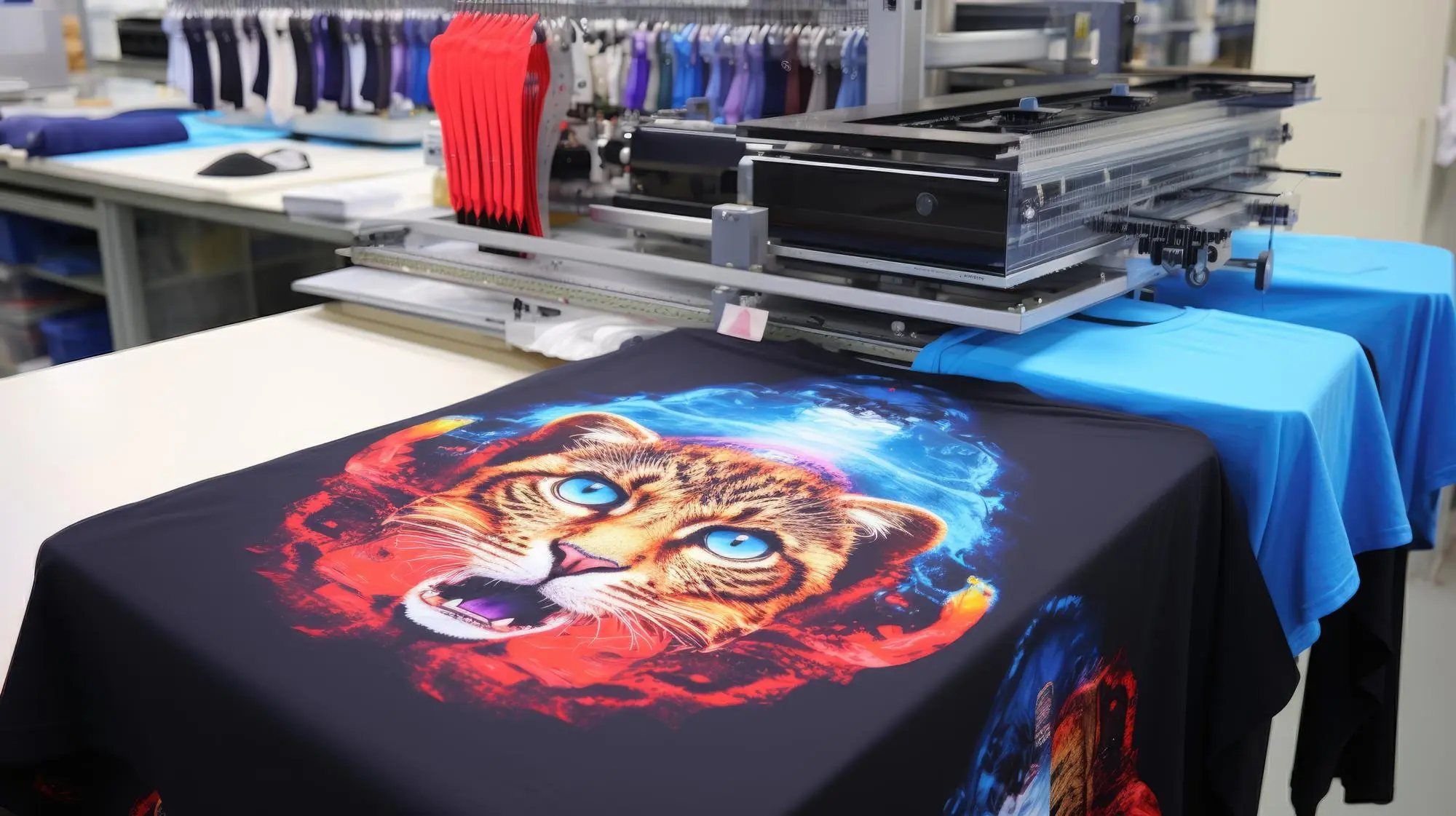
DTG is a digital technique that prints directly onto the fabric, working in a similar way to a paper printer. It makes it possible to create complex designs with a great deal of detail and precision.
It is a solution widely used for small orders and individual personalisation.
Advantages of DTG
The greatest advantage of DTG is creative flexibility. It allows you to print images with many colours, gradients and details without significant technical limitations.
It is ideal for small quantities, since it requires no prior preparation.
It also offers fast production, which makes it suitable for urgent orders.
Limitations of DTG
Durability can be lower than with screen printing, especially on darker fabrics or with intensive use.
In large quantities, the cost per unit becomes less competitive.
What DTF (Direct to Film) is
DTF is a more recent technique that has been gaining popularity. It consists of printing the design onto a special film, which is then transferred onto the t-shirt using heat.
This approach combines characteristics of DTG and screen printing, offering an interesting balance between quality, flexibility and cost.
Advantages of DTF
DTF makes it possible to print designs of high quality, including multiple colours and fine detail, with no need for screens or complex preparation.
One of its great advantages is versatility, as it can be applied to different types of fabric.
It also offers good durability, superior to DTG in many cases, especially when it is properly applied.
It is an excellent option for both small and medium quantities.
Limitations of DTF
Despite the advantages, the finish can be slightly different, with a more noticeable feel on the fabric compared with screen printing.
In very large production runs, it may not be as economical as screen printing.
Main differences between screen printing, DTG and DTF
Each technique answers different needs better, so it is important to look at the main criteria.
Production quantity
Screen printing is ideal for large volumes.
DTG is better suited to small quantities.
DTF positions itself as an intermediate solution, working well in small and medium production runs.
Design complexity
Simple designs favour screen printing.
Complex designs with many colours are ideal for DTG and DTF.
Cost
Screen printing is more economical in large quantities.
DTG is more advantageous for small orders.
DTF offers an interesting balance between cost and flexibility.
Durability
Screen printing offers the greatest resistance.
DTF offers good durability.
DTG can be less resistant depending on use.
Which technique is best for each situation
The choice always depends on the objective and on the details of the order.
For events and large groups
Screen printing is generally the best choice, especially when the design is simple and the quantity high.
For complex and personalised designs
DTG and DTF are more suitable, as they allow greater creative freedom.
For a balance between quality and flexibility
DTF stands out as a versatile solution, able to meet different needs without major limitations.
For company uniforms
Screen printing remains a safe choice thanks to its durability, although DTF can be an interesting alternative in some cases.
Impact of the technique on the final quality
The technique chosen influences not only the visual appearance, but also the comfort and the perception of the product.
A well-executed print conveys quality and professionalism, factors that are essential for personal and business use alike.
How to guarantee the best result
Whichever technique is chosen, there are good practices that should be followed.
Choose quality t-shirts
The fabric has a direct influence on the result of the print and on its durability.
Prepare the design correctly
Files with good resolution and adjusted colours guarantee better results.
Set realistic expectations
Knowing the characteristics of each technique helps to avoid surprises and to guarantee satisfaction with the final product.
Ready to create your custom t-shirts?
Configure online and get a free mockup within 24h.
Start configuring